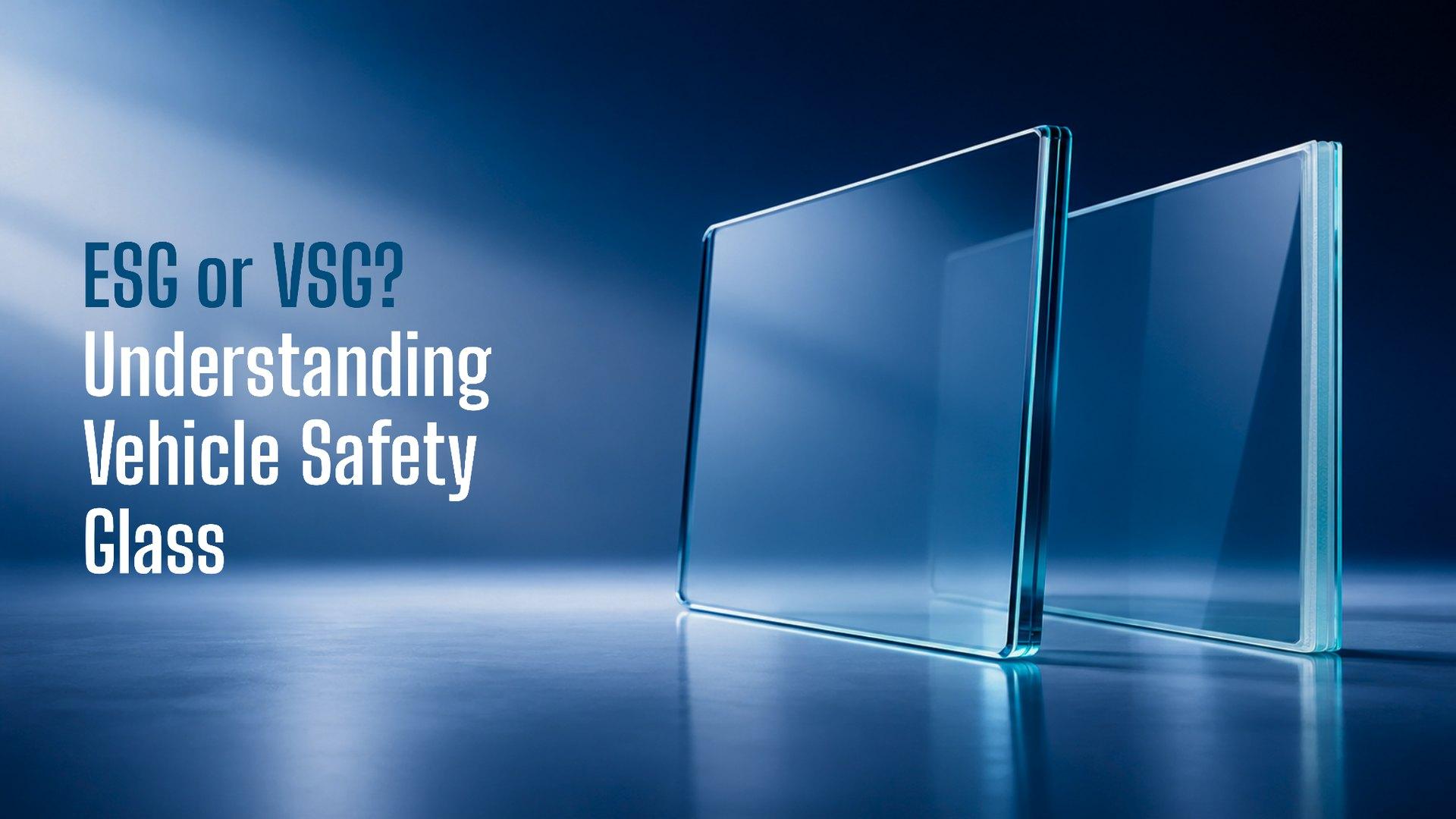
ESG and VSG can appear very similar once installed in a vehicle. Their most important differences lie beneath the surface: how they are produced and how they behave when damaged.
Both are forms of safety glazing, but they achieve safety in different ways. Let’s see how.
ESG: tempered safety glass
What ESG stands for: ESG is short for the German term Einscheiben-Sicherheitsglas. In English, it is commonly referred to as thermally toughened safety glass, or tempered safety glass.
How it is made: ESG consists of a single pane that is heated and then rapidly cooled. This process creates compressive stress at the surfaces of the glass, balanced by tensile stress in its centre. The resulting stress pattern gives ESG its increased mechanical and thermal resistance.
Strength: Toughened safety glass can be up to five times stronger than ordinary glass of the same thickness, although its exact performance depends on the product and specification.
How it breaks: When ESG fails, the stored stresses cause the whole pane to fragment into many small, relatively blunt pieces instead of large, sharp shards. This fragmentation pattern is one of its defining safety characteristics.
Where it is used: In passenger vehicles, toughened glass is commonly used for side and rear windows. At König, ESG is available for a range of driver and passenger window constructions in commercial vehicles, including opening and emergency-exit solutions. The appropriate specification depends on the vehicle and project requirements.
VSG: laminated safety glass
What VSG stands for: VSG is short for the German term Verbund-Sicherheitsglas. In English, it is known as laminated safety glass.
How it is made: VSG is produced by placing a transparent plastic interlayer between two glass panes. The layers are first pressed together to remove trapped air and create an initial bond. The assembly is then treated with heat and pressure in an autoclave, where the glass and interlayer form a single laminated unit.
Strength: VSG should not be assigned one universal strength figure. Its performance depends on the thickness and type of the individual panes, the interlayer and the complete build-up. Its distinguishing characteristic is the retention provided by that layered construction after impact.
How it breaks: The glass can crack across the impact area, but the fragments remain attached to the interlayer rather than separating and falling away. The damaged pane can therefore retain a degree of continuity after breakage.
Where it is used: VSG is commonly used for windscreens, although its use is not limited to the front of the vehicle. At König, we also offer laminated safety glass for various driver and passenger window systems in commercial vehicles, including sliding and emergency-exit constructions. The final specification depends on the window’s function and the requirements of the project.
Selecting the appropriate construction
ESG and VSG are not interchangeable versions of the same product. They respond differently to damage, and the appropriate option depends on the window’s position, function, and project specification.
We at König can provide both flat and curved ESG and VSG as part of a complete vehicle-window assembly. The glass selection is considered together with the frame, opening function, and installation requirements, rather than as an isolated material choice.
Planning a new vehicle window project? Contact our team to discuss your requirements and how we can support you from technical preparation through to manufacturing.
Have a project that looks like this?
Send us the drawing, the sample or just the requirement. Our engineering team will tell you what can be manufactured and what still needs clarifying.
Request a quote